
This post is human-written and not AI generated or edited.
If someone asked you to "think about a dog while saying the word 'cat'", could you do that? You probably could! But what specific feature about our human brains lets us do this? One neuroscience theory is that our brains have a "global workspace" that simultaneously holds the concept of a dog while we say the word cat.
This same global workspace can do other things. For example, it lets us solve problems that take multiple steps, without having to write anything down. If you were asked: "how many legs does the animal that spins webs have?", you'd first think of the animal that spins webs, which is a spider. You put the spider in your workspace, and then you think of how many legs it has: eight.
When we ask an AI (Qwen) the same spider question, it answers correctly without using any thinking tokens. So where's the AI doing its hidden thinking? Everyone, please welcome the J-space.
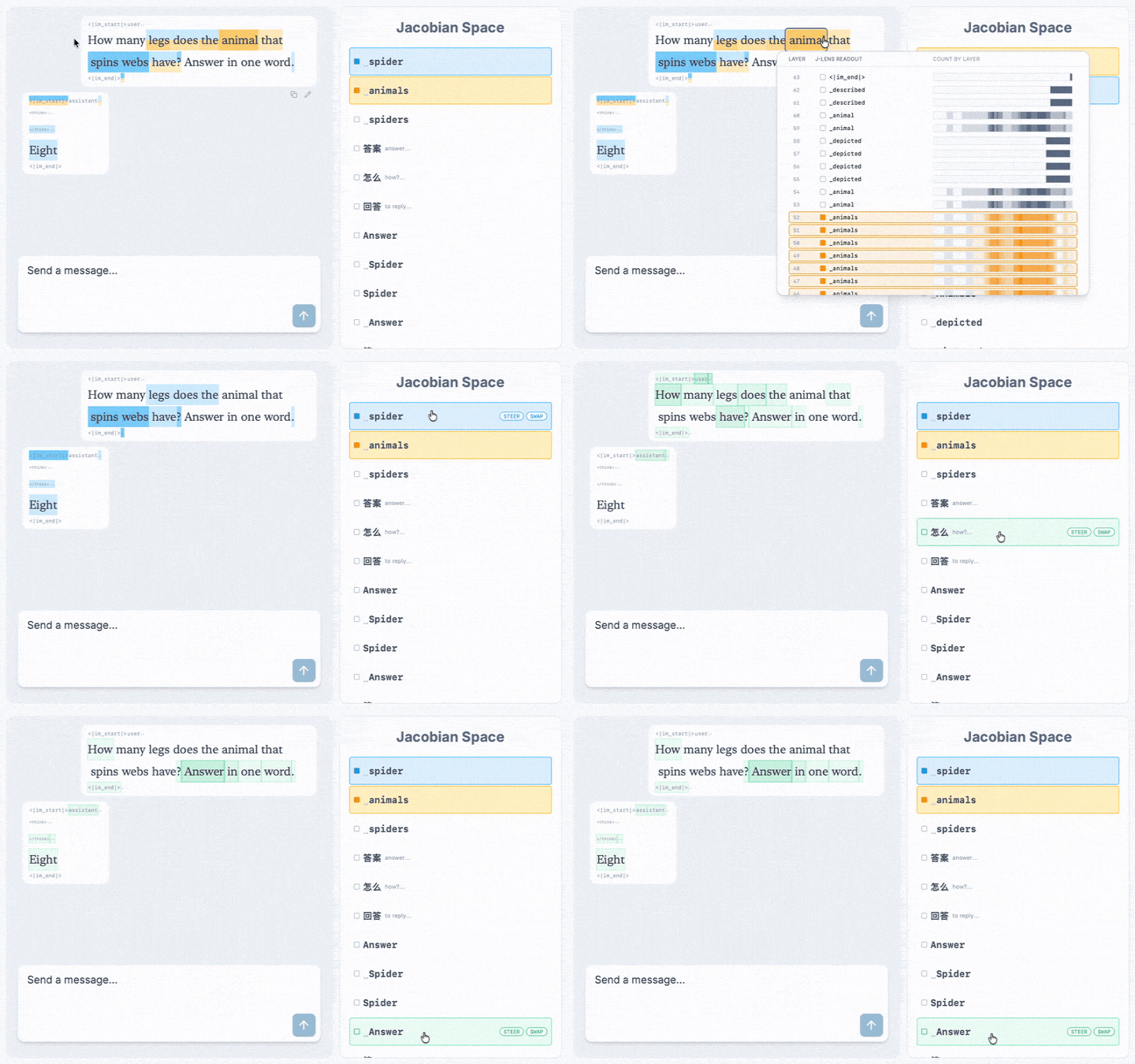
Gurnee et al argue that AI models also have a global workspace, inside what they call the Jacobian space, or J-space. The J-space can be revealed by using Jacobian lens, which are specially "fitted" for each model. In the J-lens Neuronpedia interface above, we see that the AI has "spiders" as the top entry in its J-space.
Since the launch on Monday, we've added J-lens support for 10 more models from the Gemma, Llama, GPT-OSS, and Qwen families. Access them by clicking the "Other Models" dropdown, or directly at neuronpedia.org/[modelId]/jlens. For smaller models, we noticed that it was easy to oversteer swaps - it required selecting fewer layers to swap to the desired result.
🙋 Opportunity to Contribute: Pre-fitted J-lens - We provide pre-fitted J-lenses for 36 models, with the largest being Llama 70B. We're taking contributions for more pre-fitted J-lenses that we don't have, especially larger models and different model families.
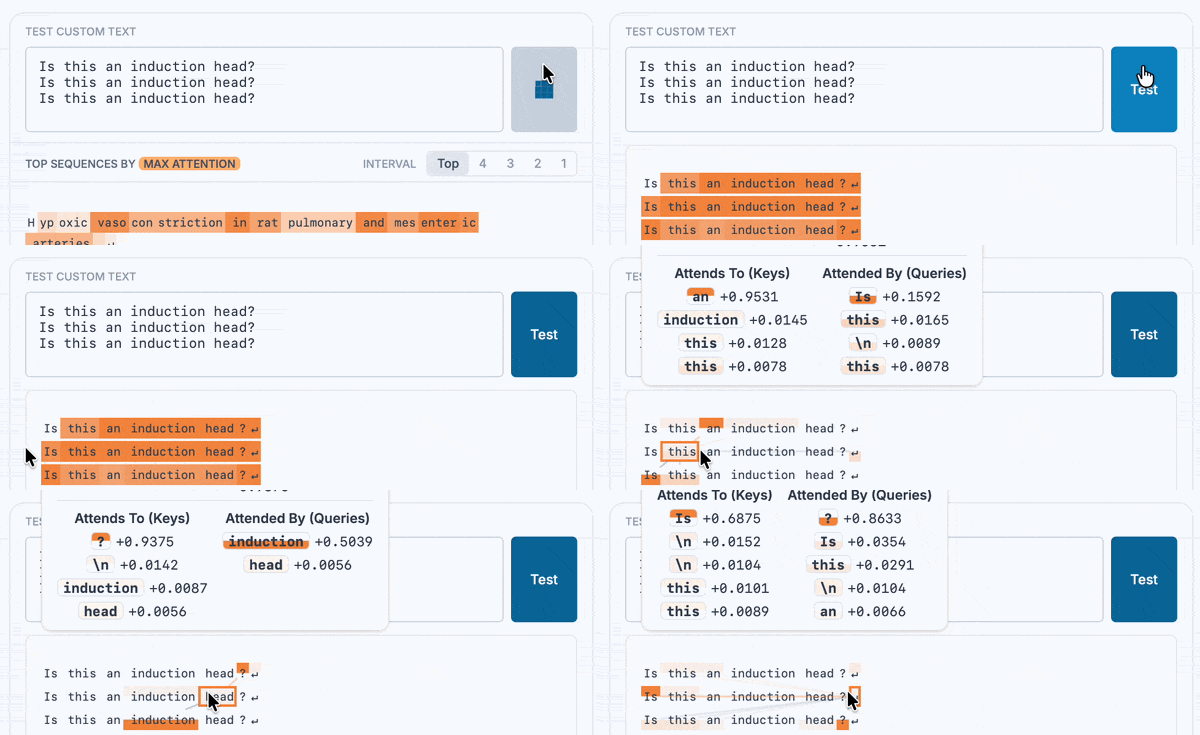
Updates to HeadVis, which was released on Neuronpedia last month.
Qwen 1.5B NLA: Can a small model have a comprehensible NLA? Andy Xu trained one (Activation Verbalizer | Activation Reconstructor), and you get to find out - try it here. We found it surprisingly workable, especially for simple concepts, though we couldn't replicate more complex things like poetry planning - let us know if you're able to!
SAELens Contributors: SAELens has seen a surge of contributions from community members - our thanks to @danra, @amaljithkuttamath, @chandrudp29, @J0YY, and of course David Chanin for keeping up with fixes and updates. Also, thanks to Michael Hanna for keeping circuit-tracer up-to-date.
InterpKit: Featured in a previous post, @z4nix continues to iterate on InterpKit with the vision of being an easy-to-use Python toolkit for mech interp on all models. New since last post - it now has a local UI supporting most of InterpKit's functionality.
As always, please contact us with your questions, feedback, and suggestions.